Quick answer: NoMeansNo Foundation and the Department of Women & Child Development, Government of NCT of Delhi, have entered into a three-year collaboration to strengthen PoSH awareness, committee capacity, institutional readiness and compliance monitoring across all 13 districts of Delhi.
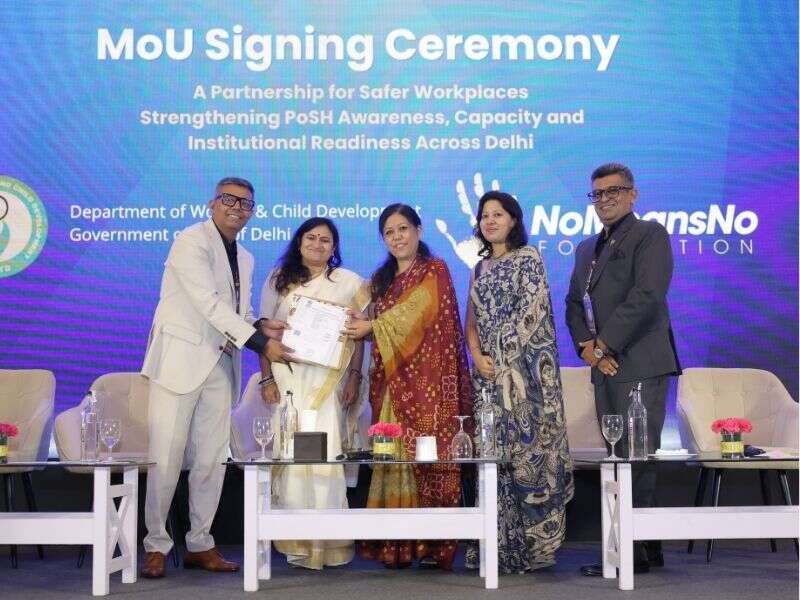
On 24 July 2026, NoMeansNo Foundation signed a Memorandum of Understanding with the Department of Women & Child Development (DWCD), Government of NCT of Delhi, establishing a structured framework for strengthening implementation of the Prevention of Sexual Harassment framework across Delhi.
The collaboration brings together DWCD’s institutional oversight and NoMeansNo Foundation’s experience in PoSH training, inquiry capacity building, leadership sensitisation, awareness generation and organisational strengthening.
The MoU is designed to support not only awareness but also the systems that make workplace safety meaningful: trained committees, procedurally sound inquiries, reliable documentation, annual reporting, district-level coordination and data-informed compliance monitoring.
What does the NoMeansNo-DWCD MoU cover?
The collaboration is structured around six major areas of PoSH implementation.
1. Capacity building for Local Committees across Delhi
NoMeansNo Foundation will conduct one structured Local Committee capacity-building programme in each of Delhi’s 13 districts every year.
These programmes are expected to address:
- Roles and responsibilities of Local Committees
- Complaint handling under the PoSH Act
- Inquiry procedures and statutory timelines
- Principles of natural justice
- Evidence handling and documentation
- Witness examination techniques
- Drafting inquiry reports
- Retaliation risks
- Procedural fairness
Local Committees have an important role in receiving complaints from establishments where an Internal Committee has not been constituted because there are fewer than ten workers, as well as complaints made against an employer. The statutory framework for Internal and Local Committees is set out in the Sexual Harassment of Women at Workplace Act, 2013.
2. PoSH training for government departments and Internal Committees
The MoU provides for twenty PoSH training programmes every year for employees and Internal Committees of government departments.
The programmes will focus on:
- Provisions of the PoSH Act
- Complaint and inquiry processes
- Documentation standards
- Leadership responsibilities
- Institutional compliance readiness
The objective is to help committees move beyond theoretical knowledge and develop the procedural clarity required to respond to complaints fairly, sensitively and consistently.
3. Technical support for Women Helpline 181
NoMeansNo Foundation will provide capacity-building and technical assistance to strengthen the preparedness of Women Helpline 181 personnel in relation to workplace sexual harassment enquiries.
This may include training, orientation, informational resources, referral protocols, technical guidance and advisory support.
4. Support for monitoring PoSH annual returns
The collaboration also addresses an area where many institutions encounter practical difficulties: preparation, submission and monitoring of annual PoSH returns.
NoMeansNo Foundation will assist District Officers with:
- Review of annual returns
- Data compilation and analysis
- Identification of reporting gaps
- Reporting support
- Structured advisory inputs
Under the PoSH Act, Internal and Local Committees must prepare annual reports, and employers must include prescribed complaint and disposal information in their organisational reporting.
5. District-level and consolidated compliance insights
The MoU envisages the preparation of district-level PoSH compliance reports and a consolidated Delhi PoSH compliance report. Analysis can help identify reporting patterns, implementation gaps and opportunities for institutional improvement while maintaining the confidentiality required under the PoSH framework.
6. District-level PoSH support volunteers
One trained PoSH support volunteer will be deployed to assist each District Officer.
Their responsibilities may include supporting annual-return compilation, administrative coordination, district-level initiatives and communication with the concerned District Magistrate’s office.
Why this collaboration matters for Delhi workplaces
PoSH compliance is not completed by adopting a policy or conducting one awareness session.
The law places continuing responsibilities on employers, including maintaining a safe working environment, displaying prescribed information, organising employee-awareness programmes, orienting Internal Committee members and supporting complaint inquiries. Section 19 of the PoSH Act specifically requires workshops and awareness programmes at regular intervals.
Non-compliance can attract a fine of up to ₹50,000. Repeated violations may lead to enhanced consequences, including issues affecting licences, approvals or registrations, as provided under Section 26 of the Act.
For organisations, meaningful compliance requires an interconnected system:
- A legally and operationally appropriate Internal Committee
- A clear workplace policy
- Regular employee sensitisation
- Practical orientation for committee members
- Leadership and manager training
- Confidential complaint-handling protocols
- Inquiry-ready documentation
- Annual reporting and recordkeeping
- Periodic compliance reviews
The MoU recognises that sustainable PoSH implementation requires capacity, coordination and monitoring at every level.
PoSH compliance support for Delhi-based organisations
Alongside its public-interest commitments under the MoU, NoMeansNo Foundation supports Delhi-based organisations seeking to strengthen their own workplace systems.
Organisation-specific support can be designed for:
- Companies and startups
- Schools, colleges and universities
- Hospitals and healthcare institutions
- NGOs, foundations and social-sector organisations
- Professional firms and associations
- Retail, hospitality and service-sector workplaces
- Multi-location employers across Delhi NCR
Support may include Total PoSH Compliance reviews, employee sensitisation workshops, Internal Committee training, leadership sessions, inquiry capacity building, documentation readiness and annual-compliance support.
Is your organisation’s PoSH system implementation-ready?
A committee existing on paper does not necessarily mean that the organisation is prepared to handle a complaint.
Decision-makers should consider:
- Is the Internal Committee properly constituted?
- Have committee members received practical inquiry training?
- Are employees sensitised at regular intervals?
- Do managers understand reporting and non-retaliation responsibilities?
- Are confidentiality and documentation protocols established?
- Is the organisation prepared for its annual reporting obligations?
- Can the committee conduct a fair, timely and well-documented inquiry?
If any answer is uncertain, a structured PoSH compliance review can identify the gaps before they become legal, cultural or reputational risks.
Strengthen your organisation’s PoSH compliance
Delhi-based organisations can contact NoMeansNo Foundation to schedule an employee PoSH workshop, register Internal Committee members for training, request a Total PoSH Compliance assessment or plan leadership and inquiry-capacity programmes.
Frequently asked questions
What is the NoMeansNo Foundation and DWCD-GNCTD MoU?
It is a three-year framework for collaboration on PoSH awareness, capacity building, institutional readiness, annual-return monitoring and district-level implementation across Delhi.
How many districts are covered?
The MoU covers all 13 districts of Delhi.
How many training programmes are planned annually?
The annual deliverables include one Local Committee capacity-building programme in each district and twenty PoSH programmes for government departments and their Internal Committees.
Does the MoU provide free training to every organisation in Delhi?
No. The defined initiatives under the MoU are undertaken pro bono in coordination with DWCD. The agreement does not create an automatic entitlement to free training for every private organisation.
Are regular PoSH workshops required for employers?
The PoSH Act requires employers to organise workshops and awareness programmes at regular intervals for employees and orientation programmes for Internal Committee members.
Can private organisations engage NoMeansNo for PoSH training?
Yes. Delhi-based organisations may independently enquire about employee sensitisation, Internal Committee training, leadership workshops, compliance reviews and other organisation-specific support.
Related Posts

How to Choose a PoSH External Member for Your IC
Choose a PoSH external member by assessing inquiry competence, neutrality, evidence handling, report writing and availability—not training credentials alone. Vishal Bhasin explains what organisations should look for when selecting support for their Internal Committee.

PoSH Training for CXOs: Leadership, Governance & Trust
PoSH training for CXOs focuses on leadership judgement, Internal Committee independence, confidentiality and workplace trust. Vishal Bhasin explains why senior leaders need a different conversation—and how NoMeansNo approaches it.

PoSH Nashik Case – A reflection on POSH training, leadership intent, and the culture gap behind recent headlines
The reality today is that POSH is no longer just about legal compliance. It directly influences how organizations are perceived — by employees, clients, investors, and future talent. An organization’s reputation is no longer defined only by its financial performance or growth numbers. Increasingly, it is shaped by how responsibly it handles difficult situations.