

A CEO gets a call late in the evening.
One of the organisation’s most successful business leaders has been named in a PoSH complaint. He has been with the company for more than a decade, handles some of its most valuable relationships and is widely regarded as someone who has contributed significantly to its growth.
The CEO listens carefully and then says something that, on the face of it, sounds perfectly reasonable.
“Can HR first speak to both of them and see whether this can be resolved?”
No threat has been made. No instruction has been given to suppress the complaint. Nobody has asked the Internal Committee to change its position. The CEO may genuinely believe that an informal conversation could prevent the matter from becoming more complicated than necessary.
And yet, something important has already happened.
Power has entered the room.
HR may now hesitate before escalating the matter formally. Someone may interpret the CEO’s suggestion as a preference. The complainant may eventually wonder whether leadership wanted the matter contained. The respondent may assume that the organisation is willing to find an informal way out. None of these outcomes may have been intended by the CEO.
That is precisely why I increasingly believe that PoSH conversations with CXOs need to begin somewhere very different from where conventional PoSH training usually begins.
A CXO does not need another definition of sexual harassment.
A CXO needs to understand what their position of power can do to a PoSH situation, sometimes without them consciously doing anything at all.
When a suggestion stops being just a suggestion
Employees need clarity around boundaries, conduct, unwelcome behaviour and reporting. Internal Committee members need a much deeper understanding of inquiry, evidence, natural justice, confidentiality, procedure and findings.
But senior leadership sits in a third, very different position.
A CEO, CHRO, business head or member of senior management may never sit in an Internal Committee hearing. Yet decisions made in their office can influence what happens before the inquiry starts, while it is progressing and after it concludes.
That influence is not necessarily negative. In fact, leadership support is essential. The organisation has to provide the Internal Committee with resources, access, time, independence and institutional backing. It has to take the process seriously. It has to ensure that employees can participate without intimidation. It ultimately has responsibilities under the statutory framework.
The difficulty is understanding where support ends and influence begins.
Imagine another situation.
A complaint has been filed against a senior revenue leader. During an internal leadership discussion, someone says, “He has worked here for fifteen years. There has never been a complaint against him.”
Someone else adds, “He manages forty per cent of the region’s business.”
Another person says, “Maybe this is just his informal style being misunderstood.”
Every one of those observations may be factually correct.
But I often ask leadership teams a very simple question at this point:
At what stage did business performance become evidence in a PoSH inquiry?
A long service record may be relevant background in some contexts. Commercial importance may be an organisational reality. A person may genuinely have been an excellent colleague to hundreds of people.
None of that determines what happened in a particular interaction with a particular individual.
This is where senior leadership sometimes faces its first uncomfortable PoSH lesson: our familiarity with a person can create a sense of certainty that the evidence itself may not support.
“I know him.”
“She would never do that.”
“He is not that kind of person.”
These are human reactions. But an Internal Committee cannot investigate personality. It has to investigate allegations.
The reverse is equally important.
The moment a complaint is filed, the respondent does not become guilty by designation. Protecting a complainant from retaliation and ensuring that she can participate meaningfully in the process does not require an organisation to prejudge the respondent.
In my experience, mature PoSH systems understand something that is occasionally lost in the heat of workplace allegations: support for the complainant and fairness to the respondent are not competing principles.
Both are part of a credible process.
A CXO therefore needs to understand natural justice not as a legal expression that belongs in an inquiry report, but as an organisational discipline. It means resisting the temptation to decide too early. It means allowing uncomfortable evidence to be tested. It means not allowing reputation to become proof of innocence, and equally not allowing accusation to become proof of guilt.
That balance sounds obvious when discussed in a training room.
It becomes much harder when the people involved are sitting three levels below you on the organisation chart and tomorrow’s business results may depend on one of them.
Perhaps CXOs do not need PoSH training at all
I have increasingly found myself questioning the phrase “PoSH training for CXOs.”
Perhaps CXOs do not need PoSH training at all.
If PoSH training means another sixty-minute presentation explaining what sexual harassment is, showing a few workplace scenarios, discussing the three-month complaint timeline and ending with the constitution of an Internal Committee, I am not sure that is the best use of a senior leadership team’s time.
The more useful conversation is about power, governance, judgement and institutional response through the lens of PoSH.
Consider a very common sentence:
“This is sensitive. Keep me updated on everything.”
It sounds responsible. A senior leader wants visibility.
But what does “everything” mean?
Should a CEO receive witness statements? Should senior management see the respondent’s detailed defence? Should business leadership know which employees have supported the complainant’s version? Should internal evidence circulate because the issue has become “important”?
Confidentiality under PoSH is not simply a request to avoid gossip. It is part of the integrity of the process.
And seniority does not automatically create a need to know.
One of the most useful conversations with leadership is therefore not about how much information they can obtain, but how little information they actually need in order to discharge their role responsibly.
There is a difference between governance information and inquiry information.
A leader may need to know that a complaint has been received, that an appropriately constituted IC is handling it, that timelines are being followed, that necessary support is being provided and, ultimately, that recommendations requiring employer action have been received.
That does not necessarily mean leadership should have a ringside seat to every deposition and every piece of evidence.
The Internal Committee is not simply another HR committee whose work can be informally supervised through the management hierarchy. It has a distinct statutory role.
Leadership oversight and leadership interference can sometimes be separated by a very thin line.
And the more powerful the leader, the thinner that line may become.
A CXO may never tell an IC member what conclusion to reach. They do not need to. Sometimes a raised eyebrow, a question about whether a complaint is “really serious enough,” or a remark about the commercial consequences of an outcome can be enough to influence the environment around an inquiry.
Again, intention may be completely benign.
But leadership must learn to distinguish intention from institutional impact.

That is why another situation interests me.
An organisation tells me proudly, “We have almost no PoSH complaints.”
The obvious response is congratulations.
The more interesting response is a question.
Why?
Maybe the workplace genuinely has very healthy professional boundaries and strong managerial behaviour.
Or maybe people do not believe that raising a complaint against someone powerful will end well for them.
A high number of complaints is not automatically evidence of a healthy culture. A low number is not automatically evidence of an unhealthy one.
The leadership competency lies in refusing to treat the number itself as the answer.
The better question is: How confident are employees that if something does happen, the organisation will deal with it fairly?
That is a very different measure.

Culture becomes visible when the complaint is inconvenient
Most organisations find it relatively easy to support PoSH when the facts are obvious, the respondent is replaceable, the complainant is credible to everyone and the consequence of acting is commercially insignificant.
The real test begins when the complaint is inconvenient.
What happens when the respondent is also the person bringing in the largest account?
What happens when the complainant is relatively junior?
What happens when the evidence is messy?
What happens when both employees are valuable?
What happens when the organisation has just announced someone’s promotion?
What happens when the senior management team personally knows one party?
What happens when the complaint arrives forty-eight hours before a major client pitch?
What happens when the outcome, whichever way it goes, will create internal disruption?
Those are the moments when culture becomes visible.
Not in the policy document.
Not on the poster near the cafeteria.
Not in the annual awareness mailer.
In the decisions made when doing the right thing becomes inconvenient.
I have been part of enough PoSH discussions to know that senior leaders naturally think about implications. Revenue. Reputation. Succession. Client relationships. Attrition. Team morale. Investor perception. Media exposure.
They are supposed to think about those things.
That is leadership.
The critical distinction is that these consequences cannot become evidence while deciding whether an allegation is established.
The organisation may subsequently have to manage commercial consequences. But the inquiry cannot be reverse-engineered to produce the least disruptive commercial outcome.
That distinction is easy to state and difficult to live.
There is another side to leadership responsibility that deserves equal attention.
What happens after an inquiry?
Suppose an allegation is established. Does the organisation implement recommendations promptly, or does somebody begin negotiating their seriousness because the respondent is commercially important?
Suppose allegations are not established. Can the respondent return to work without being permanently branded by an unproven accusation?
Suppose the complainant continues to work with people who know she filed a complaint. Who ensures that subtle retaliation does not begin through exclusion, performance narratives, transfer decisions or lost opportunities?
A PoSH matter does not become a management issue only when the complaint is filed.
Leadership behaviour before, during and after the process can determine whether employees see the organisation’s mechanism as credible.
This is where I believe many CXO programmes stop too early. They teach leaders enough law to recognise a complaint, but not enough organisational judgement to know what to do once the complaint reaches them.
Why NoMeansNo approaches the CXO room differently
At NoMeansNo, our work with senior leadership is shaped significantly by what we have seen across the wider PoSH lifecycle.
Training rooms teach you one part of PoSH.
Inquiry rooms teach you another.
When you work with Internal Committees, act as External Members, examine allegations, listen to conflicting versions, deal with documentary evidence, engage with witnesses, navigate confidentiality, consider interim measures, evaluate probabilities and watch organisations respond to difficult findings, your understanding of “PoSH training” changes.
You begin to see the small organisational decisions that matter.
Who was copied on an email.
Who called whom before the complaint formally reached the IC.
Whether the employee felt comfortable naming a powerful respondent.
Whether HR was trying to protect the process or protect the organisation from the process.
Whether an interim decision prevented retaliation or unintentionally penalised the complainant.
Whether the IC was genuinely independent or technically independent but culturally subordinate to management.
Whether senior management wanted appropriate governance visibility or detailed access to confidential inquiry material.
Whether an organisation could accept a finding it did not commercially like.
These are not usually questions answered by a standard awareness deck.
That is why we do not see CXO sensitisation as a shorter version of employee training delivered to more senior people.
It needs to be a different conversation altogether.
The discussion has to move into senior respondents, conflicts of interest, complaints involving leadership, confidentiality, retaliation, Board involvement, interim measures, organisational reputation, the role of HR, IC independence, difficult outcomes and the boundaries of leadership involvement.
It must also include something senior leaders are rarely told in corporate training:
sometimes the most responsible leadership action is to deliberately stay out.
Not disengage.
Not ignore.
Not abdicate responsibility.
But create the conditions for the statutory mechanism to work and then resist the urge to influence it.
That is a very sophisticated form of leadership.
And it is particularly difficult for people whose careers have been built around taking charge of difficult situations.
Which brings me back to the CEO at the beginning.
“Can HR first speak to both of them and see whether this can be resolved?”
At first glance, it sounds like efficient leadership.
But perhaps the better questions would have been:
“What is the nature of the complaint?”
“Does this need to go to the Internal Committee?”
“What does the law require us to do?”
“What support does the IC need from the organisation?”
“And where should I deliberately stay out?”
That difference is the reason CXO PoSH conversations matter.
At NoMeansNo, we are not particularly interested in spending valuable leadership time explaining another definition of sexual harassment.
We would rather discuss what happens when power, people, business, reputation, fairness and law arrive in the same room—and leadership has to decide what to do next.
Because that is usually where the real PoSH test begins.
Legal reference: Sexual Harassment of Women at Workplace (Prevention, Prohibition and Redressal) Act, 2013 — government source.
Bring the PoSH conversation into your leadership room
Discuss PoSH training for your CXOs and senior leadership team with NoMeansNo. Share your organisational context so we can help you explore the right approach.
Review your wider compliance framework with our 18-point PoSH Compliance Audit and Report Writing services.
Learn more about Vishal Bhasin’s PoSH experience and approach.

How to Choose a PoSH External Member for Your IC
Choose a PoSH external member by assessing inquiry competence, neutrality, evidence handling, report writing and availability—not training credentials alone. Vishal Bhasin explains what organisations should look for when selecting support for their Internal Committee.
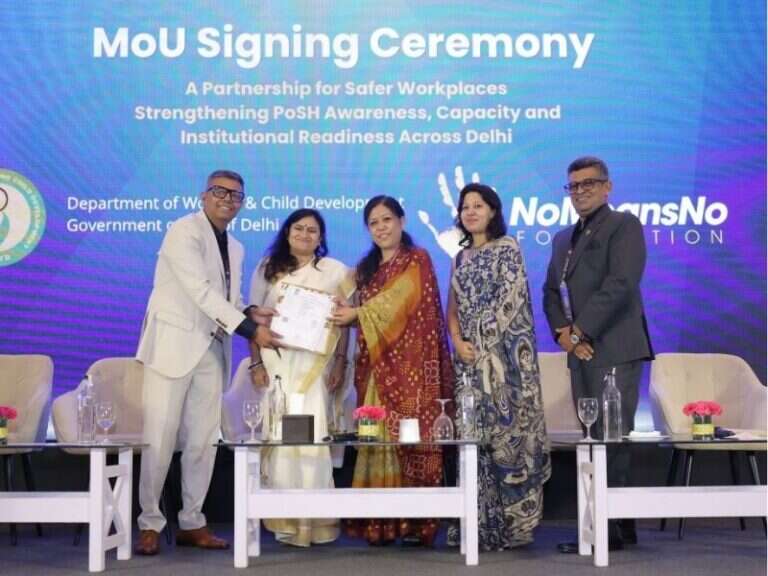
NoMeansNo Foundation and DWCD-GNCTD Sign Three-Year MoU to Strengthen PoSH Implementation Across Delhi
NoMeansNo Foundation and DWCD-GNCTD begin a three-year collaboration to strengthen PoSH training, Local Committees and compliance across all 13 districts of Delhi.
PoSH Nashik Case – A reflection on POSH training, leadership intent, and the culture gap behind recent headlines
The reality today is that POSH is no longer just about legal compliance. It directly influences how organizations are perceived — by employees, clients, investors, and future talent. An organization’s reputation is no longer defined only by its financial performance or growth numbers. Increasingly, it is shaped by how responsibly it handles difficult situations.