Trusted Partner for PoSH and POCSO Compliance & Trainings
Understand your organisation’s PoSH compliance through NoMeansNo’s 18-point synthesis. Review policy, committee preparedness, awareness, support and reporting with a structured assessment that helps leadership identify priorities for action.
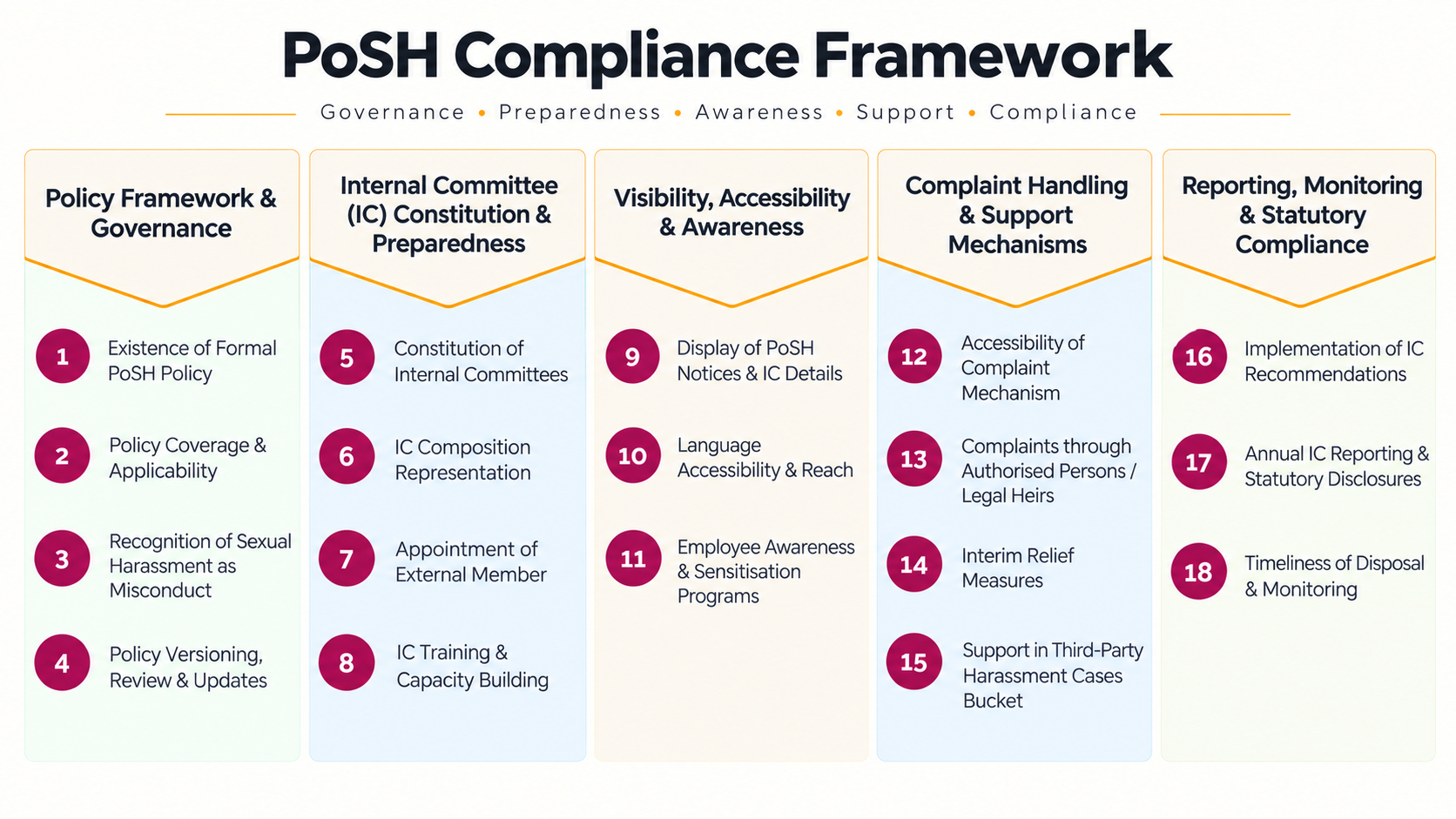
Explore the 18-point framework. Select the image to enlarge it; each audit area is explained below.
Tell us the support you need. We’ll discuss your locations, documentation and reporting requirements before defining the scope.
Please share business contact details only. Case records can be discussed through an agreed confidential process.
A PoSH Compliance Audit reviews how an organisation’s policies, people, processes and records support prevention and redressal of workplace sexual harassment. It connects what is documented with the evidence available about implementation.
NoMeansNo’s 18-point synthesis brings these areas into one structured view. The assessment considers statutory requirements and implementation maturity within an agreed scope, helping HR, legal, compliance and leadership teams understand what is in place and what needs attention.
Examine the framework across five connected themes instead of reviewing each document in isolation.
Bring aspect-wise observations together in a report that leadership can use for review and planning.
Use the assessment to agree practical next steps, responsibilities and further support.
These are the areas we examine. The depth of review, evidence requirements and assessment approach are tailored during scoping. Each point below describes the focus of the audit; detailed findings remain specific to your organisation.
A clear policy establishes how prevention, prohibition and redressal work across the organisation.
Review whether a documented policy provides a clear foundation for prevention, reporting and redressal, with identifiable organisational ownership.
Examine how the policy addresses employees, consultants, contractors and relevant third parties across workplaces and work-related settings.
Check alignment between the PoSH policy, service rules and code of conduct so that misconduct and disciplinary responsibilities are clearly addressed.
Review how policy versions, amendments and communication of updates are maintained as organisational needs and applicable requirements evolve.
A committee needs both an appropriate structure and the capability to fulfil its role.
Review constitution records and workplace coverage to understand whether appropriate Internal Committees are in place for the organisation’s structure.
Examine the committee’s membership, Presiding Officer and women’s representation against applicable composition requirements.
Review the external member’s appointment, eligibility and defined role in supporting the committee’s independence and functioning.
Assess orientation and capacity-building records covering inquiry procedures, confidentiality, timelines and principles of natural justice.
Policies become useful when people can find, understand and act on them.
Review the visibility and currency of workplace notices, committee details and information about reporting channels.
Consider whether communications are understandable and accessible to the workforce, including contractual personnel and relevant language groups.
Review awareness initiatives, induction and learning records to understand the reach and continuity of employee sensitisation.
Accessible processes and appropriate support help an organisation respond responsibly when a concern is raised.
Examine whether people can identify and access the Internal Committee and designated complaint channels without avoidable procedural barriers.
Review provisions for complaints made on behalf of an aggrieved woman in circumstances permitted by the applicable law and rules.
Assess how the framework addresses interim measures during an inquiry, including the committee’s role and the employer’s implementation responsibilities.
Review how the organisation addresses incidents involving non-employees and provides appropriate assistance through relevant support and reporting routes.
Documented follow-through connects committee work with accountable organisational action.
Review how recommendations are received, assigned for action and tracked through implementation within applicable requirements.
Examine annual reporting arrangements, the information maintained and the process for relevant employer disclosures and submissions.
Review how complaint timelines, reporting milestones and oversight are monitored, including readiness where no complaints have been recorded.
PoSH Report Writing brings the evidence reviewed, observations and overall assessment into a coherent document. NoMeansNo structures the compliance report around the agreed scope and the 18 review areas, so the reader can follow how the assessment was reached.
Define the organisation, locations, reporting period and review boundaries relevant to the engagement.
Present the review areas and evidence-based observations in an organised, readable format.
Explain the compliance posture, implementation maturity and priorities for follow-up within the agreed scope.
An annual IC report serves a different purpose from an audit assessment. Where needed, discuss support for annual reporting and employer disclosures as a separate workstream. A report about an individual complaint is also distinct: the Internal Committee retains its statutory inquiry and findings responsibilities.
The relevant legal framework includes the Sexual Harassment of Women at Workplace Act, 2013. Sections 19, 21 and 22 address employer duties, committee annual reporting and employer reporting respectively. Applicable requirements are considered during scoping; the 18-point synthesis is NoMeansNo’s assessment method, not a government certification.
PoSH Total Compliance services can connect the audit findings with the work needed to strengthen your framework. Depending on the engagement, this may involve policy updates, committee readiness, awareness programmes, external-member support and reporting coordination.
Clarify policy ownership, review cycles and implementation priorities across the organisation.
Identify relevant employee awareness and Internal Committee capacity-building needs.
Agree documentation, reporting and monitoring support based on the gaps identified.
Explore related support: external members for Internal Committees, employee awareness training and PoSH 360 for IC members.
Discuss entities, locations, workforce context and whether you need an audit, report writing or broader implementation support.
Agree the records and access arrangements, then examine the material against the relevant review areas.
Bring the aspect-wise review into an overall assessment, with context and limitations made clear.
Review the written output and agree priorities and any separately scoped follow-up support.
Policy documents, committee constitution records, training records, communication materials and reporting arrangements may form part of the review. The exact evidence request is agreed for the engagement; there is no need to upload confidential records through this enquiry form.
The service is relevant to employers, HR and people teams, legal and compliance functions, leadership teams and Internal Committees seeking a consolidated view of their PoSH framework. It can help when reviewing multiple locations, refreshing policies, assessing committee preparedness or organising reporting.
NoMeansNo has used its 18-point framework in an organisational compliance assessment and written report. The approach combines document review, implementation mechanisms and reporting practices to assess both compliance arrangements and maturity.
The review draws on NoMeansNo’s wider PoSH training and compliance work. Learn more about Vishal Bhasin’s experience in PoSH training and external-member support. Client identities, records and engagement-specific findings are not published here.
A PoSH Compliance Audit is an evidence-based review of an organisation’s prevention, prohibition and redressal framework. NoMeansNo’s 18-point synthesis examines policies, Internal Committee readiness, awareness, complaint support and reporting, then brings the observations together in a structured assessment.
It covers 18 review areas grouped into five themes: policy governance; Internal Committee constitution and preparedness; visibility and awareness; complaint handling and support; and reporting, monitoring and statutory compliance. The review considers both documentation and implementation evidence within the agreed scope.
The core deliverable is a structured compliance assessment report with an agreed scope, aspect-wise observations, an overall assessment and priorities for follow-up. Annual IC reporting and employer-disclosure support can be discussed separately according to your reporting needs.
No. A compliance audit report evaluates the organisation’s wider framework. An annual IC report records prescribed information for the relevant reporting period. An inquiry report concerns a particular complaint and remains a separate process with the Internal Committee’s responsibilities intact.
No. The 18-point synthesis is NoMeansNo’s assessment framework. It supports review and improvement of compliance arrangements; it is not a government certification, a guarantee of compliance or a substitute for an employer’s and Internal Committee’s responsibilities.
Yes. An absence of recorded complaints does not by itself establish policy accessibility, committee readiness, awareness or reporting quality. The audit can examine those arrangements and the evidence supporting them.
The records needed, access arrangements and reporting audience are agreed during scoping. Start with organisational details in the enquiry form; sensitive complaint narratives and personal case records should be shared only through the agreed process.
Scope, fees and timelines depend on the number of entities and locations, available documentation and the support required. Share your organisation’s requirements to receive a scoped proposal.
Yes. The findings can inform a coordinated plan for policy improvements, committee preparedness, awareness, external-member support and reporting. The workstreams and follow-up responsibilities are agreed for the engagement.
Start with an 18-point review, a structured written report or a conversation about PoSH Total Compliance services. Tell us what your organisation needs and we’ll help define the next step.