PoSH Training has evolved significantly in Indian workplaces. What initially began as awareness-building initiatives has, by 2026, matured into a structured statutory compliance requirement aligned with the duties imposed on employers under the PoSH Act.
Today, PoSH training is expected to be conducted at regular intervals, designed according to organisational roles, and supported by proper documentation. It plays a central role in ensuring that organisations meet their compliance checklist obligations, including accurate disclosures in annual PoSH returns and effective implementation of preventive mechanisms.
This guide explains PoSH Training in India in 2026—covering legal requirements, types of training, frequency, formats, leadership responsibilities, and best practices for compliant workplaces.
What Is PoSH Training?
PoSH Training refers to structured awareness and capacity-building programmes conducted in furtherance of the Sexual Harassment of Women at Workplace (Prevention, Prohibition and Redressal) framework.
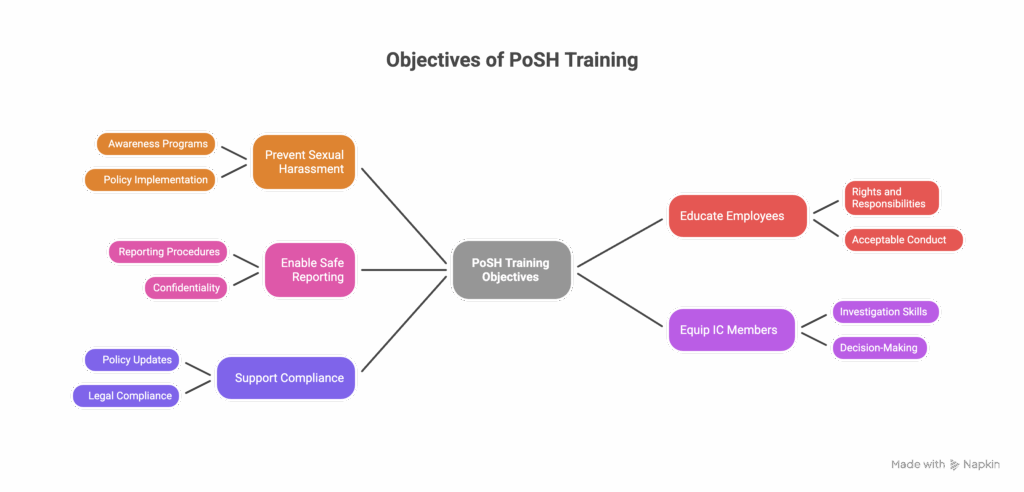
The objectives of PoSH training are to:
Prevent sexual harassment at the workplace
Educate employees on rights, responsibilities, and acceptable conduct
Enable safe and effective reporting of concerns
Equip Internal Committee (IC) members to discharge their statutory functions
Support organisational compliance with the PoSH Act
PoSH training is not a generic soft-skills or behavioural workshop. It is a statutory compliance activity that must be aligned with legal expectations and workplace realities.
Is PoSH Training Mandatory in 2026?
Yes. PoSH Training is mandatory and must be conducted at regular intervals.
The PoSH Act places a clear obligation on employers to:
Prevent sexual harassment
Create awareness among employees
Sensitise management and leadership
Ensure effective functioning of redressal mechanisms
Government advisories, implementation guidelines, and enforcement practices have consistently clarified that training and awareness programmes must be periodic, not one-time activities.
In 2026, PoSH compliance is evaluated not merely on the existence of a policy or Internal Committee, but on whether:
Employees receive regular PoSH sensitisation
Internal Committee members are adequately trained
Leadership demonstrates awareness and accountability
Absence of regular PoSH training is widely treated as incomplete compliance.
Who Needs PoSH Training?
Effective PoSH compliance requires role-specific training, not a single generic session for all.
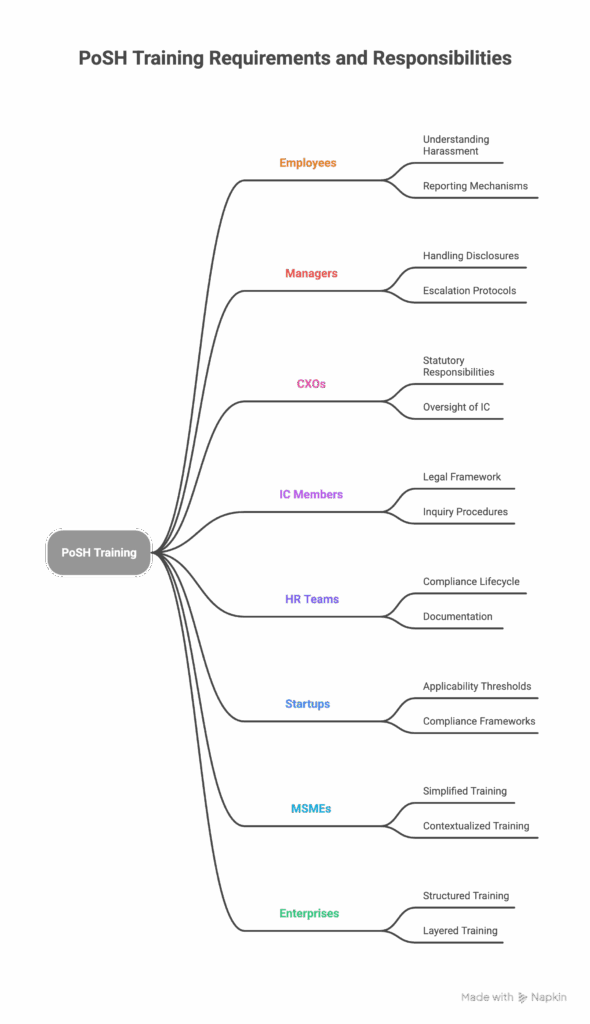
Employees (All Genders)
Employee PoSH training focuses on:
Understanding what constitutes sexual harassment
Workplace behaviour and boundaries
Reporting mechanisms
Protection against retaliation
This applies to permanent employees, contractual workers, consultants, interns, and trainees.
Managers and Supervisors
Managers play a critical role in prevention and early response. Their training typically covers:
Handling disclosures responsibly
Escalation protocols
Interim measures
Preventing victimisation or retaliation
Managerial sensitisation is an essential compliance safeguard.
CXOs, Senior Leadership & Board Members
In 2026, PoSH compliance is recognised as a leadership and governance responsibility.
CXO and Board-level PoSH training focuses on:
Statutory responsibilities of senior management
Oversight of Internal Committee functioning
Organisational accountability and tone-from-the-top
Review of compliance status and annual PoSH returns
Ensuring independence, resources, and effectiveness of PoSH mechanisms
Well-informed leadership strengthens organisational credibility and compliance continuity.
Internal Committee (IC) Members
Internal Committee members require specialised and in-depth training. Their role is statutory and quasi-judicial.
IC training must cover:
Legal framework under the PoSH Act
Inquiry procedures and timelines
Principles of natural justice
Evidence assessment
Report writing and recommendations
Generic awareness sessions are not sufficient for IC members.
HR and Compliance Teams
HR and compliance teams require clarity on:
End-to-end PoSH compliance lifecycle
Documentation and record-keeping
Coordination with IC and management
Annual return preparation and disclosures
Startups, MSMEs, and Enterprises
Startups are covered once applicability thresholds are met
MSMEs require simplified but compliant training frameworks
Large enterprises require structured, layered training
Training must be contextualised to organisational size and sector.
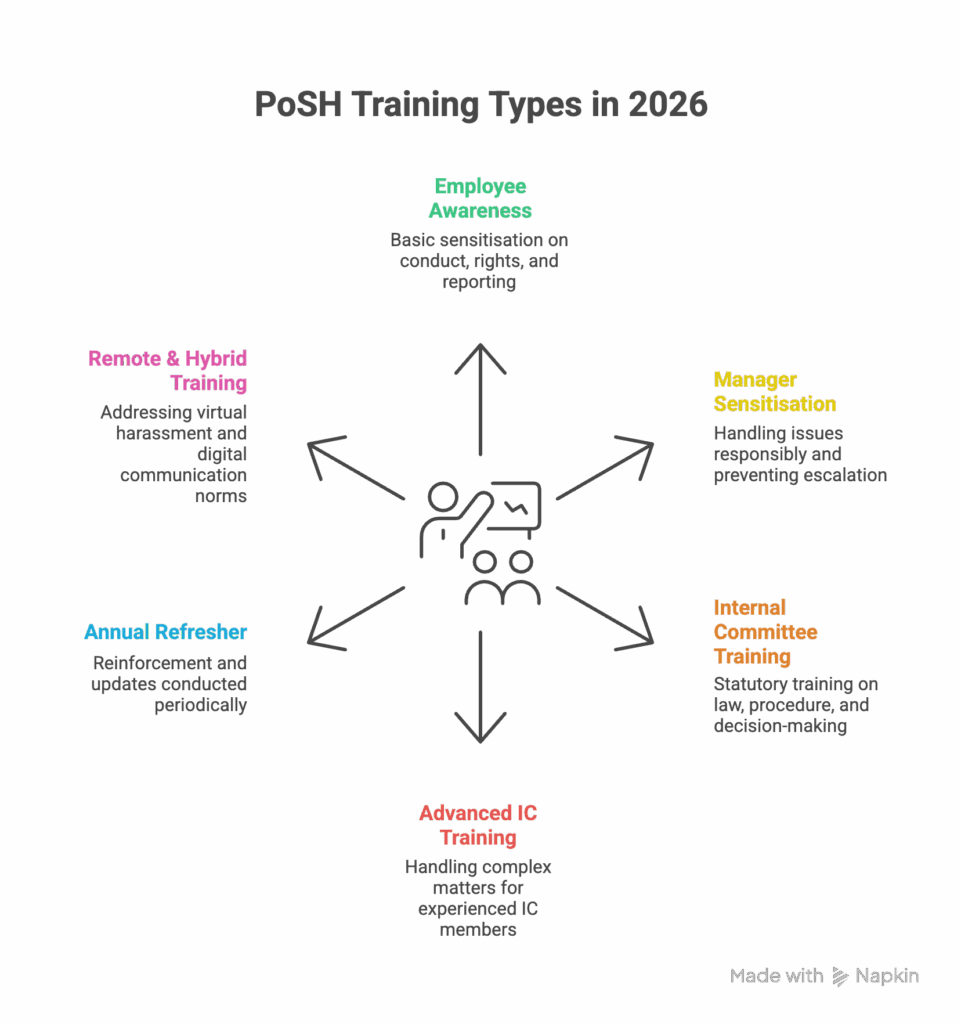
Types of PoSH Training in 2026
Organisations typically conduct multiple forms of PoSH training:
Employee Awareness Training
Basic sensitisation on conduct, rights, and reporting.
Manager Sensitisation Training
Focused on handling issues responsibly and preventing escalation failures.
Internal Committee (IC) Training
Statutory training on law, procedure, and decision-making.
Advanced IC / Investigator Training
For experienced IC members handling complex matters.
Annual Refresher Training
Reinforcement and updates conducted periodically.
PoSH Training for Remote & Hybrid Workplaces
Addresses virtual harassment and digital communication norms.
Online vs Offline PoSH Training in 2026
Online PoSH Training
Suitable for:
Employee awareness programmes
Distributed or remote teams
Refresher training
Offline PoSH Training
Strongly recommended for:
IC training
Manager and leadership sensitisation
Advanced workshops
Hybrid Training Models
A blended approach is widely adopted in 2026 to balance reach and depth.
How Often Should PoSH Training Be Conducted?
Best-practice expectations in 2026 include:
Employees: At regular intervals, typically annually
New joiners: At onboarding
Managers & leadership: Periodically or on role change
IC members: On appointment and through refreshers
Regular training supports sustained compliance and awareness.
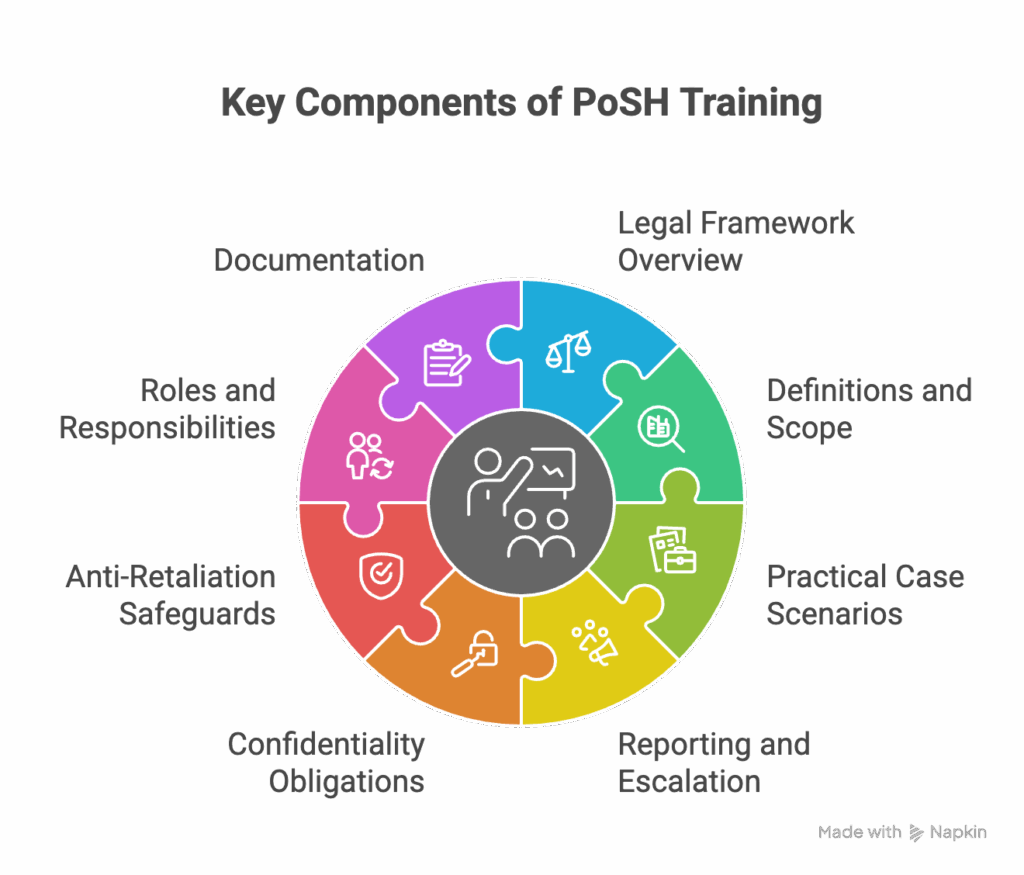
What a Compliant PoSH Training Program Must Include
A compliant PoSH training programme typically includes:
Overview of the PoSH legal framework
Definitions and scope of workplace
Practical case scenarios
Reporting and escalation mechanisms
Confidentiality obligations
Anti-retaliation safeguards
Roles and responsibilities
Documentation aligned with annual PoSH compliance requirements, including attendance records and training summaries
Common PoSH Training Gaps Organisations Must Avoid
Common compliance gaps include:
Treating PoSH training as a one-time exercise
Using generic, non-contextual content
Not conducting IC-specific training
Absence of training records
Ignoring leadership sensitisation
Addressing these gaps is essential for sustained compliance.
How to Choose the Right PoSH Training Partner
When selecting a PoSH training provider, organisations should assess:
Legal expertise and subject-matter depth
Practical experience with PoSH implementation
Ability to customise training by role and sector
Quality of training methodology
Support for compliance documentation
Training quality directly impacts compliance effectiveness.
PoSH Training by NoMeansNo
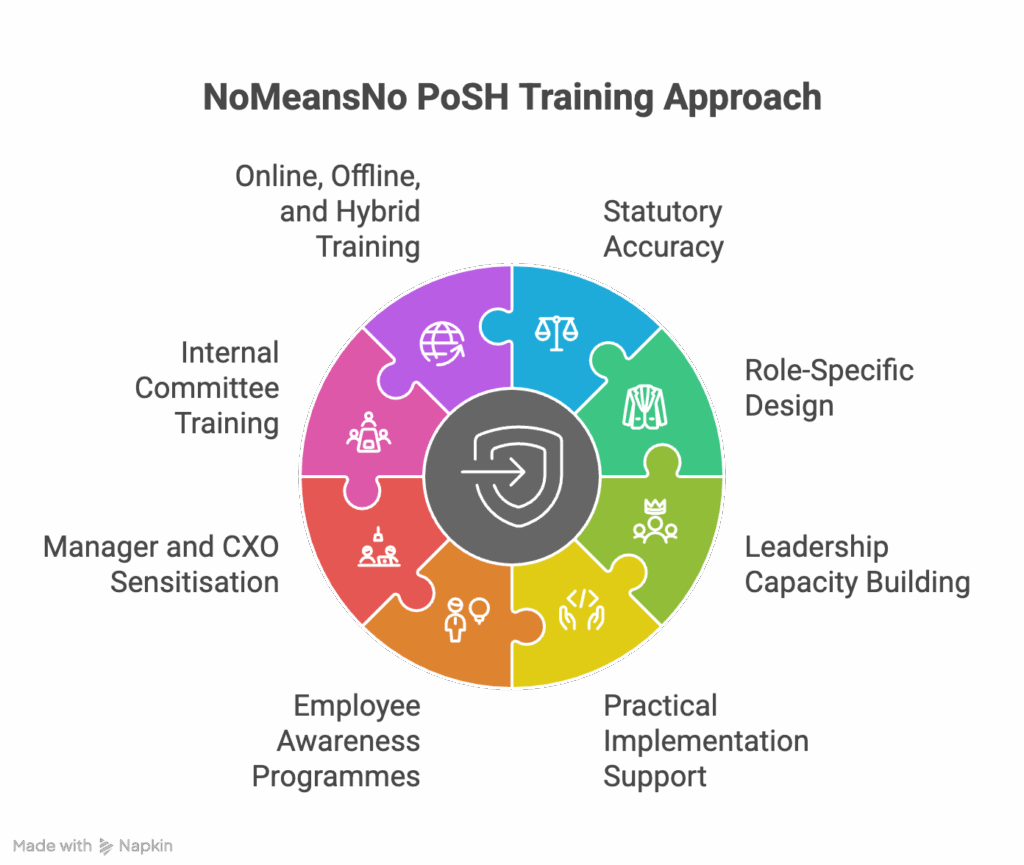
At NoMeansNo, PoSH training is designed as a compliance-centric and governance-aligned intervention.
Our approach emphasises:
Statutory accuracy
Role-specific programme design
Leadership and IC capacity building
Practical implementation support
We deliver:
Online, offline, and hybrid PoSH training across India
PoSH training is approached as a core compliance pillar, not a standalone activity.
FAQ's
Is PoSH training mandatory every year?
PoSH training must be conducted at regular intervals. Annual training is widely followed as best practice.
Is online PoSH training legally valid?
Online training is valid for awareness purposes. IC and leadership training are best conducted in interactive formats.
Who can conduct PoSH training?
Training should be conducted by individuals or institutions with demonstrable expertise in the PoSH framework.
Is PoSH training mandatory for men?
Yes. PoSH training applies to all employees, irrespective of gender.
Does PoSH training apply to startups?
Yes. Once applicability thresholds are met, startups are required to comply.
What proof of PoSH training should employers maintain?
Attendance records, training content outlines, and trainer credentials aligned with annual compliance requirements.
PoSH Training Is a Core Compliance Pillar in 2026. PoSH training is a statutory and operational necessity for Indian employers. Conducting training at regular intervals, across roles and leadership levels, is central to fulfilling obligations under the PoSH Act. Organisations that adopt structured, periodic, and role-specific PoSH training frameworks are better positioned to: Maintain compliance continuity , Meet annual return requirements, and foster safe and accountable workplaces PoSH training is no longer an isolated activity—it is a core pillar of sustained workplace compliance.
#NoMeansNo