
Why PoSH in 2026 demands governance intelligence, not templates or checklists
As India steps into 2026, the Prevention of Sexual Harassment of Women at Workplace Act, 2013 (“PoSH Act”) is no longer a “new” law, a compliance add-on, or an HR-driven obligation. It has firmly entered its governance era.
Over the past decade, regulatory expectations, judicial scrutiny, and workforce awareness have converged to make one reality clear:
PoSH compliance failures are now treated as systemic governance failures, not isolated HR lapses.
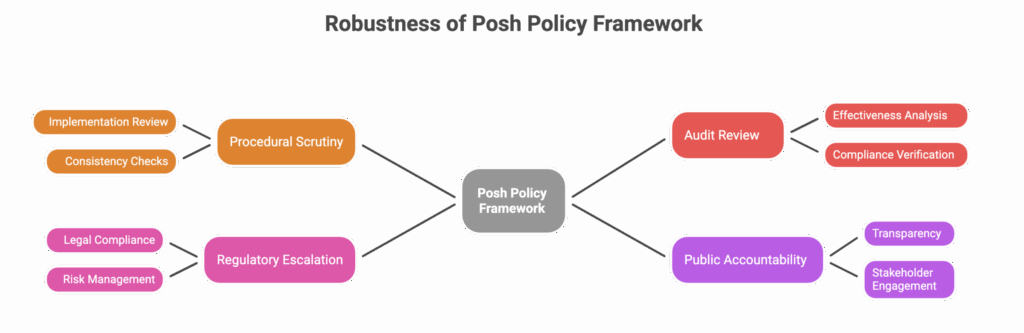
In 2026, organisations are no longer judged on whether they have a PoSH policy or an Internal Committee on paper. They are assessed on whether their PoSH framework can withstand:
Procedural scrutiny
Audit review
Regulatory escalation
And, increasingly, public accountability
This article presents a 2026-ready statutory interpretation framework, synthesised from 183 PoSH interpretive positions, to clarify what the law actually requires, where organisations continue to go wrong, and how PoSH must now be approached—as compliance intelligence, not compliance ritual.
PoSH in 2026: From HR Compliance to Non-Delegable Governance Duty
By 2026, it is no longer credible to view PoSH as an HR-owned process.
The PoSH Act imposes a non-delegable statutory duty on the employer to:
-
Prevent sexual harassment
-
Provide a legally valid redressal mechanism
-
Ensure procedural fairness
-
Protect dignity at the workplace
Courts and authorities increasingly evaluate PoSH through a governance lens, asking:
-
Was the Internal Committee validly constituted?
-
Was due process followed?
-
Were statutory timelines respected?
-
Was retaliation prevented?
-
Were reporting obligations met?
In this context, “intent” or “good faith effort” is insufficient. Outcomes and process integrity now matter more than intent.
Redefining the “Workplace” in a Post Pandemic, Digital-First 2026
The most persistent PoSH confusion entering 2026 remains the definition of “workplace”.
The PoSH Act deliberately avoids a narrow, location-based definition. Instead, it adopts an employment nexus test, making the law adaptable to evolving work realities.
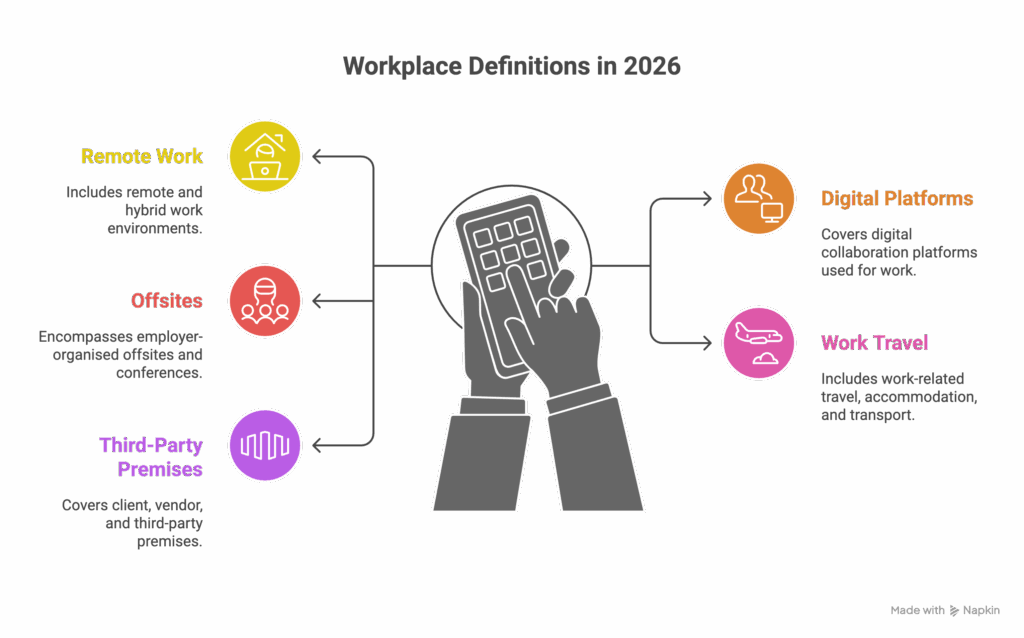
In 2026, the workplace clearly includes:
Remote and hybrid work environments
Digital collaboration platforms used for work
Employer-organised offsites and conferences
Work-related travel, accommodation, and transport
Client, vendor, and third-party premises
Organisations that continue to rely on outdated “office-only” interpretations expose themselves to avoidable risk.
Sexual Harassment: Impact, Context, and the Single-Incident Principle
By 2026, jurisprudence and practice have firmly settled three principles:
A single incident can constitute sexual harassment
Impact on the aggrieved woman outweighs the respondent’s intent
Context matters more than labels or familiarity
The law recognises both quid pro quo harassment and hostile work environment creation. At the same time, it retains boundaries, requiring conduct to be sexual in nature and unwelcome.
In 2026, the compliance risk lies not in over-reporting, but in misclassification, either minimising conduct that meets the legal threshold or overreaching without statutory grounding.
Internal Committees in 2026: Quasi-Judicial Bodies Under Scrutiny
In 2026, ICs are increasingly viewed as quasi-judicial statutory bodies, expected to demonstrate:
Independence
Impartiality
Procedural discipline
Reasoned decision-making
Recurring failures include:
Invalid composition (especially external member deficiencies)
Undisclosed conflicts of interest
Management interference post-inquiry
An invalid IC invalidates the inquiry, regardless of the complaint’s merits. This reality has become non-negotiable by 2026.
Inquiry Processes: Why “Informal Handling” Is No Longer Defensible
By 2026, informal PoSH handling has become a major red flag.
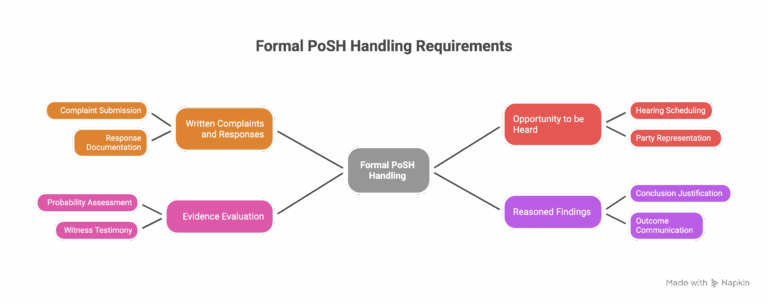
The law mandates:
Written complaints and responses
Opportunity to be heard
Evidence evaluation on preponderance of probabilities
Reasoned findings
Shortcuts, fact-finding calls, informal reconciliations, or management-led resolutions do not survive scrutiny.
In 2026, procedural lapses are often treated as independent violations, irrespective of outcome.
Interim Relief and Conciliation: Narrow Provisions, High Misuse Risk
Interim relief and conciliation remain exceptional tools, not default mechanisms.
Key clarifications that matter in 2026:
Both require the aggrieved woman’s request
Conciliation cannot involve monetary settlement
Interim relief must be proportionate and protective
Pressuring complainants into “mutual resolution” to avoid inquiry is now widely recognised as a compliance failure, not pragmatism.
Findings, Penalties, and Malicious Complaint Claims
By 2026, it is well established that:
An unproven complaint is not a false complaint
Malice requires intentional falsity, proven through evidence
Organisations invoking malicious complaint provisions casually often create greater legal exposure than the original complaint.
Confidentiality and Retaliation: Secondary Violations with Primary Consequences
In 2026, retaliation is increasingly treated as a standalone governance failure.
Confidentiality breaches through emails, informal disclosures, or internal gossip, compound risk. Courts and regulators view these as indicators of systemic failure rather than isolated lapses.
Documentation, neutrality, and restraint are no longer optional safeguards.
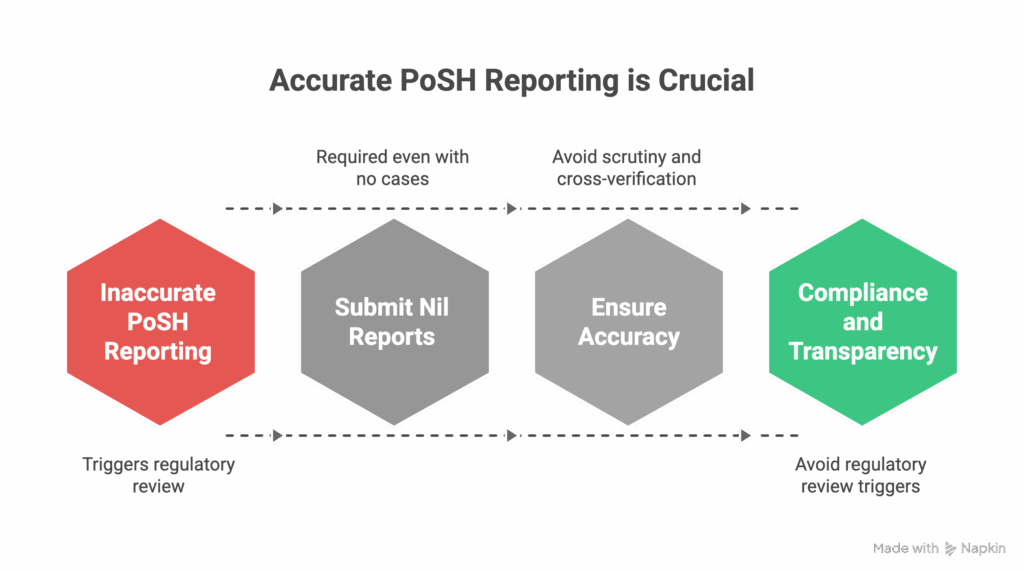
Annual PoSH Reporting in 2026: From Formality to Audit Trigger
Annual PoSH Reports are now recognised as compliance artefacts, not administrative paperwork.
By 2026:
Nil-reporting years still require submission
Inaccurate reporting invites scrutiny
District Officers (DO’s) ask for supporting documents during inspections
Failure to submit or misreport is often the first trigger for deeper regulatory review.
Law Versus Best Practice: A Critical Distinction in 2026
One of the most important PoSH lessons entering 2026 is this:
Best practice strengthens compliance, but cannot replace the law.
Organisations must clearly separate:
Statutory obligations (non-negotiable), from
Governance enhancements (contextual, non-statutory)
Blurring this line creates risk, not resilience.
Why PoSH in 2026 Demands Intelligence, Not Ritual
In 2026, PoSH compliance has matured beyond policies, posters, and basic annual trainings.
It now demands:
Advanced PoSH Trainings (Mastering the finer nuances)
Statutory literacy
Procedural integrity
Governance accountability
Organisations that continue to approach PoSH as a ritual remain exposed. Those that treat it as compliance intelligence build systems and conduct robust trainings and internal audits that are fair, defensible, and resilient.
The question in 2026 is no longer “Do we comply with PoSH?”
It is:
“Can our PoSH framework withstand scrutiny?”
FAQ's
What is PoSH compliance in India?
PoSH compliance in India refers to an employer’s statutory obligation under the Sexual Harassment of Women at Workplace (Prevention, Prohibition and Redressal) Act, 2013 to prevent sexual harassment, constitute a valid Internal Committee, conduct inquiries in accordance with law, maintain confidentiality, and comply with reporting and regulatory requirements.
Is PoSH compliance mandatory for all organisations?
Yes. PoSH compliance is mandatory for every workplace in India that employs ten or more employees. Organisations with fewer than ten employees are covered through the Local Committee mechanism notified by the District Officer.
What is the role of the Internal Committee under the PoSH Act?
The Internal Committee is a statutory, quasi-judicial body responsible for receiving complaints, conducting inquiries in accordance with principles of natural justice, and making findings and recommendations under the PoSH Act.
Can PoSH complaints be filed against non-employees or third parties?
Yes. Complaints can be filed against third parties such as clients, vendors, consultants, or visitors if the alleged conduct occurs at the workplace or arises out of or during the course of employment.
What is considered a workplace under the PoSH Act?
The definition of workplace under the PoSH Act is broad and includes physical offices, work-from-home arrangements, employer-provided transport, client locations, offsites, conferences, hotels during work travel, and digital workspaces where there is an employment nexus.
Is a single incident sufficient to constitute sexual harassment?
Yes. A single incident can constitute sexual harassment under the PoSH Act if it meets the statutory threshold of unwelcome conduct of a sexual nature.
Does intent matter in determining sexual harassment?
The PoSH Act prioritises the impact of the conduct on the aggrieved woman over the respondent’s intent. Lack of intent or claims of humour do not negate sexual harassment if the conduct is unwelcome and sexual in nature.
Is PoSH training mandatory for employees?
Employers are required to undertake awareness and sensitisation measures. PoSH training is a key compliance enabler but does not, by itself, constitute full PoSH compliance.
Is PoSH training sufficient for compliance?
No. PoSH training alone is not sufficient. Compliance requires valid IC constitution, lawful inquiry processes, documentation, reporting, and adherence to statutory obligations beyond training.
What is the inquiry process under the PoSH Act?
The inquiry process involves receipt of a written complaint, opportunity for both parties to be heard, examination of evidence, adherence to timelines, and issuance of reasoned findings based on the preponderance of probabilities.
Can PoSH inquiries be handled informally?
No. Informal handling or management-led resolution outside the statutory inquiry process is not legally defensible and exposes the organisation to compliance risk.
Is conciliation allowed under the PoSH Act?
Yes, but only at the request of the aggrieved woman and only before the inquiry begins. Monetary settlement is expressly prohibited during conciliation.
What is a malicious complaint under the PoSH Act?
A malicious complaint requires proof of intentional falsehood. Mere inability to prove allegations does not constitute a malicious complaint under Section 14 of the PoSH Act.
Is filing an Annual PoSH Report mandatory?
Yes. Every employer required to constitute an Internal Committee must submit an Annual PoSH Report, even if no complaints were received during the year.
What is SheBOX under the PoSH framework?
SheBOX (Sexual Harassment Electronic Box) is a centralised online complaint management and monitoring system administered by the Ministry of Women and Child Development, Government of India.
How should organisations approach PoSH compliance in 2026?
In 2026, PoSH compliance must be approached as a governance intelligence function, combining statutory literacy, procedural integrity, and accountability, rather than as a checklist, policy document, or training exercise.
This 2026 PoSH article is based on a consolidated statutory interpretation framework comprising 183 PoSH compliance positions covering workplace scope, inquiry mechanics, reporting obligations, and regulatory oversight mechanisms. It is intended for employers, Internal Committee members, auditors, and compliance professionals seeking law-grounded clarity in a mature regulatory environment.
#NoMeansNo